


Up to 130-Meter Range
Capture large machinery, vehicles, aircraft, buildings, bridges, and complete environments from safe working distances.


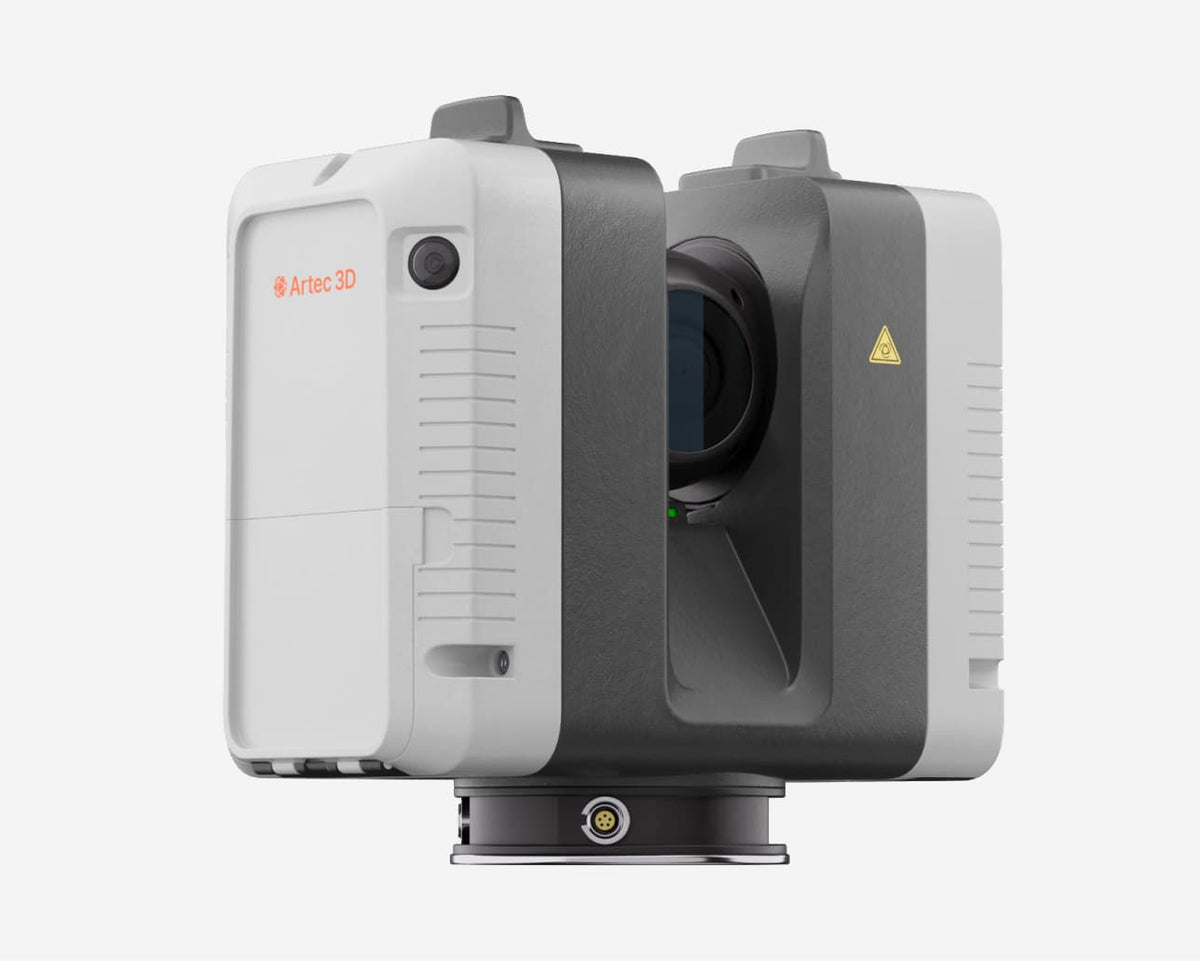
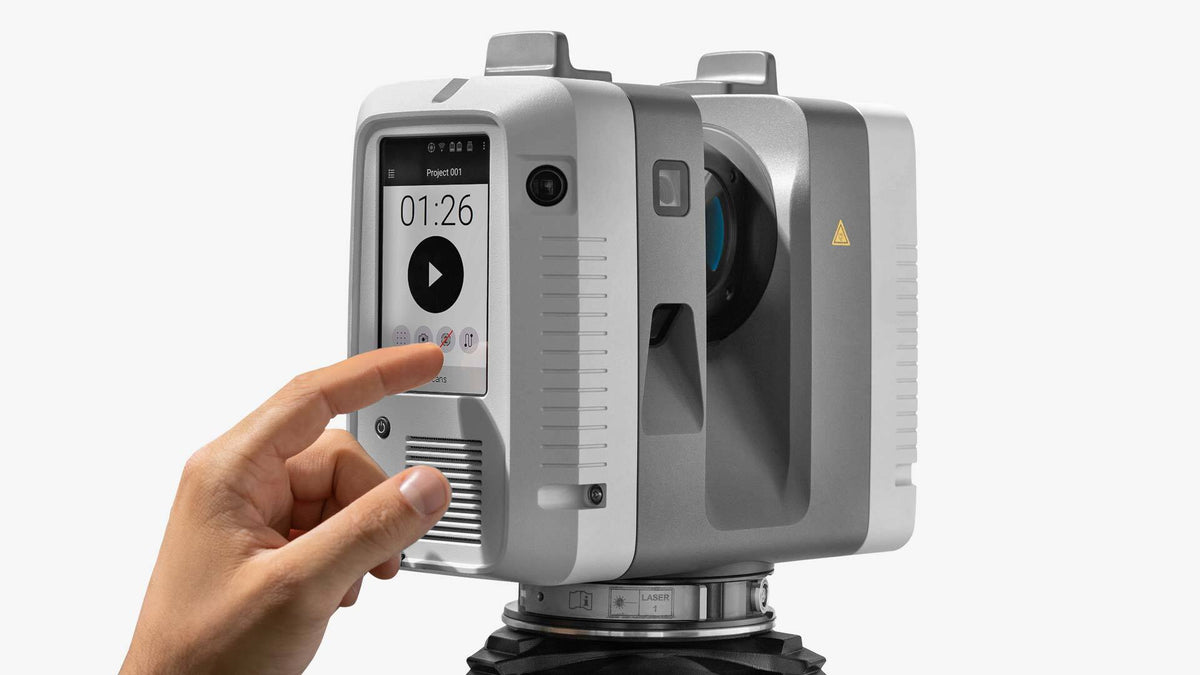
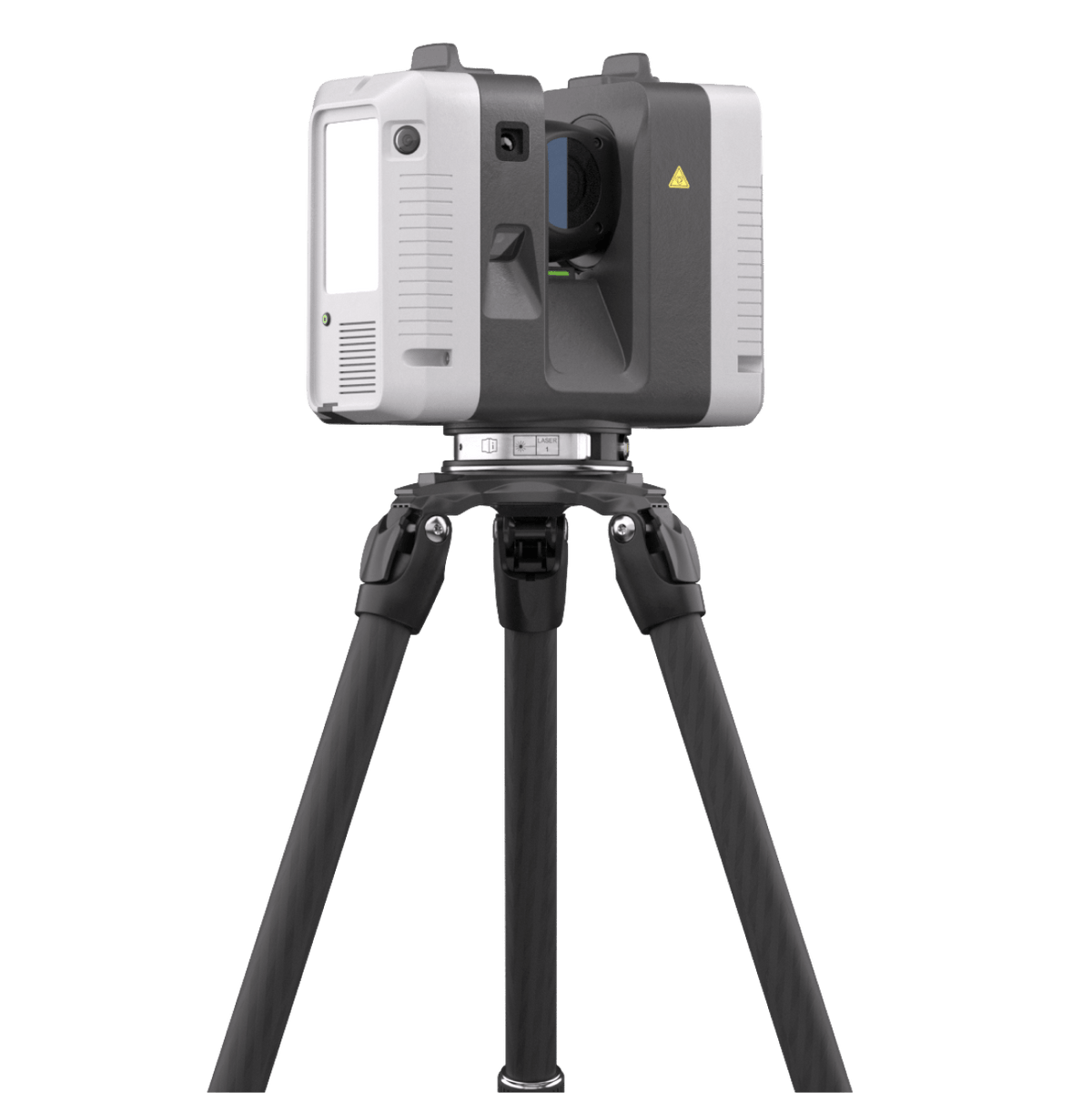
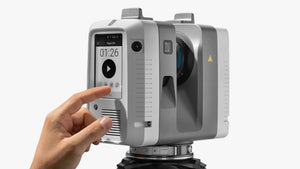
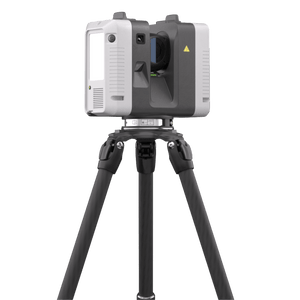
Artec Ray II is a high-accuracy long-range terrestrial LiDAR scanner for capturing vehicles, aircraft, industrial equipment, buildings, infrastructure, forensic scenes, and complete sites from distances up to 130 meters.

Ray II combines rapid LiDAR capture, precision measurement, HDR color, real-time registration, wireless control, and portable operation for demanding engineering and documentation projects.
Capture large machinery, vehicles, aircraft, buildings, bridges, and complete environments from safe working distances.
Rapidly collect dense point clouds to reduce field time and increase throughput on large scanning projects.
Achieve approximately 1.9 mm 3D point accuracy at 10 meters for engineering, inspection, and analysis.
Visual Inertial System tracking helps pre-align scan positions as you move through a project.
A 36 MP three-camera system creates realistic 360° color point clouds with automatic HDR bracketing.
Control settings, review placement, and launch captures remotely using the Artec Remote mobile app.
Explore official Artec Ray II imagery showing the scanner, industrial capture, HDR texture, scan-to-CAD, aerospace, automotive, and digital-twin workflows.
Portable long-range LiDAR scanning for large objects, buildings, vehicles, and industrial sites.

Capture complex machinery, piping, production environments, and large industrial assets.

Use the 36 MP three-camera system to create detailed, realistic color point clouds.

Process Ray II data in Artec Studio for CAD fitting, reverse engineering, and inspection.

Capture aircraft structures, engines, wings, landing gear, and large aerospace assemblies.

Digitize vehicles and production environments for inspection, crash analysis, and design.

Create high-accuracy digital representations of equipment, facilities, and infrastructure.

Combine long-range scene capture with detailed handheld scanning for complete 3D models.
All product and application imagery in this section is served directly from Artec 3D.
1. Position: Place Ray II at the first scan location and choose the required resolution and texture settings.
2. Capture: Scan a 360° × 300° field of view while recording geometry and optional HDR color.
3. Reposition: Move around the object or site while VIS tracking helps pre-align scans.
4. Process: Use Artec Studio for registration, cleanup, measurement, meshing, CAD fitting, and export.
Key specifications for the Artec Ray II long-range terrestrial LiDAR scanner.
| Scanner type | Long-range terrestrial LiDAR 3D laser scanner |
|---|---|
| Scanning range | 0.5 to 130 meters |
| Field of view | 360° horizontal × 300° vertical |
| 3D point accuracy | 1.9 mm at 10 m; 2.9 mm at 20 m; 5.3 mm at 40 m |
| Angular accuracy | 18 arcseconds, equivalent to 0.87 mm at 10 m |
| Range accuracy | 1.0 mm + 10 ppm |
| Selectable resolution | 3 mm, 6 mm, or 12 mm at 10 m |
| Maximum capture rate | Up to 2,000,000 points per second |
| Fastest full-dome scan | 26 seconds without texture at 12 mm resolution |
| Color capture | 36 MP three-camera system with automatic five-bracket HDR |
| Registration aids | Visual Inertial System, altimeter, compass, GNSS |
| Remote operation | Artec Remote app for compatible iOS and Android devices |
| Environmental protection | IP54 water and dust protection |
| Internal storage | 256 GB USB 3.0 flash storage |
| Output formats | OBJ, PLY, WRL, STL, AOP, ASC, PTX, E57, XYZRGB; CAD export via supported workflows |
Ray II is optimized for projects where the complete geometry of a large object or environment must be captured quickly and accurately.
Capture heavy machinery, vehicles, structures, piping, and legacy assets for CAD reconstruction and retrofit projects.
Use high-quality point clouds for deformation analysis, CAD comparison, crash testing, and large-component inspection.
Digitize facilities, equipment, and infrastructure for planning, maintenance, simulation, and lifecycle management.
Use Ray II for complete long-range coverage, then add Artec Leo for smaller details, recessed areas, and close-range geometry.
Ray II rapidly captures the full vehicle, aircraft, machine, building, or industrial environment.
Artec Leo records smaller features, edges, recesses, and high-detail local areas.
Combine long-range and handheld scans in Artec Studio for complete multi-resolution 3D models.
Rapid Scan 3D is an authorized Artec 3D reseller, Gold Certified Partner, and Artec Ambassador with more than 15 years of professional 3D scanning experience.
We evaluate range, object size, accuracy, site conditions, software, deliverables, and scanning strategy.
Evaluate Ray II on vehicles, industrial environments, buildings, infrastructure, or other large-scale applications.
Get help with field setup, scan planning, registration, Artec Studio, inspection, and scan-to-CAD workflows.
Common questions about range, accuracy, scan speed, applications, color capture, remote operation, software, and pricing.
Tell Rapid Scan 3D what you need to capture, the object or site size, required accuracy, working distance, environment, software, and final deliverable.
| Technical | Eva | Eva Lite | Space Spider | Leo | Micro | Ray II | Metrology Kit Professional | Metrology Kit Entry |
|---|---|---|---|---|---|---|---|---|
| Scanner type | Handheld | Handheld | Handheld | Handheld | Desktop | Tripod | Mobile | Mobile |
| 3D point accuracy , up to | 0.1 mm | 0.1 mm | 0.05 mm | 0.1 mm | 0.01 mm | 1.9 mm @10 m Angular 18" (0.87 mm @ 10 m) |
0.002 mm + 0.005 mm/m (RMS) 0.003 mm + 0.007 mm/m (3 sigma) |
0.004 mm + 0.006 mm/m (RMS) 0.005 m + 0.009 mm/m (3 sigma) |
| 3D resolution , up to | 0.2 mm | 0.5 mm | 0.1 mm | 0.2 mm | 0.029 mm | 3 / 6 / 12 mm @ 10 m | 30.3 megapixels (6720 × 4480) | 20.2 megapixels (5472 × 3648) |
| 3D accuracy over distance, up to | 0.1 mm + 0.3 mm/m | 0.1 mm + 0.3 mm/m | 0.05 mm + 0.3 mm/m | 0.1 mm + 0.3 mm/m | — | Range noise: 0.4 mm @ 10 m 0.5 mm @20 m |
0.003 mm + 0.007 mm/m (3 sigma) | 0.005 mm + 0.009 mm/m (3 sigma) |
| HD Mode | Yes | No | N/A | Yes | N/A | HDR: Automatic, 5 brackets | N/A | N/A |
| Hybrid geometry and texture tracking | Yes | No | Yes | Yes | N/A | N/A | Targets | Targets |
| Data processing algorithms | Geometry and texture based | Geometry based | Geometry and texture based | Geometry and texture based | Geometry based | Real time registration, Automatic removal of moving objects, Check & Adjust | __ | __ |
| Working distance | 0.4 – 1 m | 0.4 – 1 m | 0.2 – 0.3 m | 0.35 – 1.2 m | — | 0.5 to 130 m | __ | __ |
| Volume capture zone | 61,000 cm³ | 61,000 cm³ | 2,000 cm³ | 160,000 cm³ | 324 cm³ | 360 degrees | 65 × 46° | __ |
| Linear field of view, H×W @ closest range | 214 × 148 mm | 214 × 148 mm | 90 × 70 mm | 244 × 142 mm | — | __ | __ | __ |
| Linear field of view, H×W @ furthest range | 536 × 371 mm | 536 × 371 mm | 180 × 140 mm | 838 × 488 mm | — | __ | __ | __ |
| Angular field of view, H×W | 30 × 21° | 30 × 21° | 30 × 21° | 38.5 × 23° | — | __ | __ | __ |
| Ability to capture texture | Yes | No | Yes | Yes | Yes | Yes | Yes | Yes |
| Texture resolution | 1.3 mp | — | 1.3 mp | 2.3 mp | 6.4 mp | 36 mp | 30.3 mp | 20.2 mp |
| Colors | 24 bpp | — | 24 bpp | 24 bpp | 24 bpp | 432 MPx raw data | 30.3 megapixels (6720 × 4480) | 20.2 megapixels (5472 × 3648) |
| 3D reconstruction rate for real-time fusion, up to | 16 fps | 16 fps | 7.5 fps | 22 fps | — | __ | __ | __ |
| 3D reconstruction rate for 3D video recording, up to | 16 fps | 16 fps | 7.5 fps | 44 fps | — | __ | __ | __ |
| 3D reconstruction rate for 3D video streaming, up to | — | — | — | 80 fps | — | __ | Up to 8 images per second | Up to 4 images per second |
| Data acquisition speed, up to |
18 mln points/s | 2 mln points/s | 1 mln points/s | 35 mln points/s | 1 mln points/s | Up to 2,000,000 pts/sec | ||
| 3D exposure time | 0.0002 s | 0.0002 s | 0.0002 s | 0.0002 s | Customizable | __ | __ | __ |
| 2D exposure time | 0.00035 s | 0.00035 s | 0.0002 s | 0.0002 s | Customizable | __ | __ | __ |
| 3D light source | Flashbulb | Flashbulb | Blue LED | VCSEL | Blue LED | 36 MP 3-camera system captures 432 MPx raw data for calibrated 360° × 300° spherical image | Canon EOS R | Canon EOS 6D |
| 2D light source | White 12 LED array | White 12 LED array | White 6 LED array | White 12 LED array | RGB LED | LiDAR | White-light flash | White-light flash |
| Position sensors | — | — | — | Built-in 9 DoF inertial system | — | Visual Inertial System (VIS), Altimeter, compass, and Global Navigation Satellite System. | ||
| Display/touchscreen | USB streaming through external computer | USB streaming through external computer | USB streaming through external computer | Integrated 5.5" half HD, CTP. Optional Wi-Fi/Ethernet video streaming to external device |
USB streaming through external computer |
Onboard screen | __ | __ |
| Multi-core processing | On external computer | On external computer | On external computer | Embedded processors: NVIDIA® Jetson™ TX2 Quad-core ARM® Cortex®-A57 MPCore Processor NVIDIA Maxwell™ 1 TFLOPS GPU with 256 NVIDIA® CUDA® Cores |
On external computer | On external computer | __ | __ |
| Interface | 1 × USB 2.0, USB 3.0 compatible | 1 × USB 2.0, USB 3.0 compatible | 1 × USB 2.0, USB 3.0 compatible | Wi-Fi, Ethernet | USB 3.0 | Wireless: Integrated wireless LAN (802.11 b/g/n) |
__ | __ |
| Internal hard drive | — | — | — | 512 GB SSD | — | AS256, 256 GB/USB 3.0 flash drive | __ | __ |
| Computer requirements | Visit the Artec Support Center for detailed hardware requirements. |
Visit the Artec Support Center for detailed hardware requirements. |
Visit the Artec Support Center for detailed hardware requirements. |
Visit the Artec Support Center for detailed hardware requirements. |
Visit the Artec Support Center for detailed hardware requirements. |
Visit the Artec Support Center for detailed hardware requirements. |
Visit the Artec Support Center for detailed hardware requirements. |
Visit the Artec Support Center for detailed hardware requirements. |
| Supported OS | Windows 8.1, 10 (x64), Windows 11 | Windows 8.1, 10 (x64), Windows 11 | Windows 8.1, 10 (x64), Windows 11 | Scanning: No computer required Data processing: Windows 8.1, 10 (x64), Windows 11 |
Windows 10 (x64) | Windows 8.1, 10 (x64), Windows 11 | Windows 8.1, 10 (x64), Windows 11 | Windows 8.1, 10 (x64), Windows 11 |
| Recommended computer requirements | Intel Core i7 or i9, 64+ GB RAM, NVIDIA GPU with 8+ GB VRAM, CUDA 6.0+ |
Intel Core i7 or i9, 32 GB RAM, GPU with 2 GB VRAM | Intel Core i7 or i9, 32 GB RAM, GPU with 2 GB VRAM | Intel Core i7 or i9, 64+ GB RAM, NVIDIA GPU with 8+ GB VRAM, CUDA 6.0+ | Intel Core i7 or i9, 64+ GB RAM, NVIDIA GPU with at least 3 GB VRAM, CUDA 3.5+ | Intel Core i7 or i9, 64+ GB RAM, NVIDIA GPU with at least 3 GB VRAM, CUDA 3.5+ | Intel Core i7 or i9, 64+ GB RAM, NVIDIA GPU with at least 3 GB VRAM, CUDA 3.5+ | Intel Core i7 or i9, 64+ GB RAM, NVIDIA GPU with at least 3 GB VRAM, CUDA 3.5+ |
| Minimum computer requirements | HD: Intel Core i7 or i9, 32 GB RAM, NVIDIA GPU with CUDA 6.0+ and at least 2 GB VRAM SD: Intel Core i5, i7 or i9, 12 GB RAM, GPU with 2 GB VRAM |
Intel Core i5, i7 or i9, 12 GB RAM, GPU with 2 GB VRAM | Intel Core i5, i7 or i9, 18 GB RAM, GPU with 2 GB VRAM | HD: Intel Core i7 or i9, 32 GB RAM, NVIDIA GPU with CUDA 6.0+ and at least 4 GB VRAM SD: Intel Core i5, i7 or i9, 32 GB RAM, GPU with 2 GB VRAM A computer is needed only for data processing. Scanning does not require a computer. |
Intel Core i5, i7 or i9, 32GB RAM, GPU with 2 GB VRAM | HD: Intel Core i7 or i9, 32 GB RAM, NVIDIA GPU with CUDA 6.0+ and at least 2 GB VRAM SD: Intel Core i5, i7 or i9, 12 GB RAM, GPU with 2 GB VRAM |
HD: Intel Core i7 or i9, 32 GB RAM, NVIDIA GPU with CUDA 6.0+ and at least 2 GB VRAM SD: Intel Core i5, i7 or i9, 12 GB RAM, GPU with 2 GB VRAM |
HD: Intel Core i7 or i9, 32 GB RAM, NVIDIA GPU with CUDA 6.0+ and at least 2 GB VRAM SD: Intel Core i5, i7 or i9, 12 GB RAM, GPU with 2 GB VRAM |
| Output formats | ||||||||
| 3D mesh | OBJ, PLY, WRL, STL, AOP, ASC, PTX, E57, XYZRGB | OBJ, PLY, WRL, STL, AOP, ASC, PTX, E57, XYZRGB | OBJ, PLY, WRL, STL, AOP, ASC, PTX, E57, XYZRGB | OBJ, PLY, WRL, STL, AOP, ASC, PTX, E57, XYZRGB | OBJ, PLY, WRL, STL, AOP, ASC, PTX, E57, XYZRGB | OBJ, PLY, WRL, STL, AOP, ASC, PTX, E57, XYZRGB | OBJ, PLY, WRL, STL, AOP, ASC, PTX, E57, XYZRGB | OBJ, PLY, WRL, STL, AOP, ASC, PTX, E57, XYZRGB |
| CAD | STEP, IGES, X_T | STEP, IGES, X_T | STEP, IGES, X_T | STEP, IGES, X_T | STEP, IGES, X_T | STEP, IGES, X_T | STEP, IGES, X_T | STEP, IGES, X_T |
| Measurements | CSV, DXF, XML | CSV, DXF, XML | CSV, DXF, XML | CSV, DXF, XML | CSV, DXF, XML | CSV, DXF, XML | CSV, DXF, XML | CSV, DXF, XML |
| Power source and dimensions | ||||||||
| Power source | AC power or external battery pack |
AC power or external battery pack |
AC power or external battery pack |
Built-in exchangeable battery, optional AC power | AC power | Internal Battery 2 × AEB364 internal, rechargeable Li-Ion batteries, up to 4 hours |
Li-ion battery | Li-ion battery |
| Dimensions, H×D×W | 262 × 158 × 63 mm | 262 × 158 × 63 mm | 190 × 140 × 130 mm | 231 × 162 × 230 mm | 290 × 290 × 340 mm | 520 × 430 × 250 mm | 870 × 230 × 170 mm | |
| Weight | 0.9 kg / 2 lb | 0.9 kg / 2 lb | 0.8 kg / 1.8 lb | 2.6 kg / 5.7 lb | 12 kg / 2 | 5.35 kg / 11.7 lbs, | 12 kg / 26.5 lb |